

 CFP
CFP
How much will we end up spending on defence?

In 2025, the European Union took an important step regarding the defence of Member States through SAFE – Security Action for Europe, a new European instrument designed to support defence investments and strengthen critical capacities, innovation, and the defence industrial and technological base. Defence is an essential function of the State, which cannot be delegated and is assuming increased relevance in a context of deteriorating European and international security. The essential debate is not about the legitimacy of this investment, but about the transparency of the decisions, the financial sustainability of these choices, and their long term budgetary impact.
SAFE is a European programme that provides financing to Member States for defence investment through very long term loans — up to 45 years, with grace periods of up to 10 years. It also provides the possibility of pre financing, in a model that resembles, in several aspects, the Recovery and Resilience Facility (RRF). Although these resources are mobilised at the European Union level, the liabilities are national: the loans are recorded as public debt and will have to be repaid by the Member States, interest will be borne by national budgets, and the operating, maintenance and sustainment costs of the acquired capabilities will require financial effort from national taxpayers for decades. It is therefore not expected that a temporary and exceptional instrument such as SAFE will permanently finance structural expenditure.
Portugal expressed early interest in participating in SAFE. In September 2025, a preliminary amount available to the country was indicated, with formal validation by the European Commission occurring in January of this year. [1],[2] This period corresponded to the normal procedural stages under SAFE, involving the submission of an Investment Plan for the European Defence Industry, its evaluation, and the final European level decision on eligible amounts. In this context, the Government publicly acknowledged the need to revise the Military Programming Law (LPM) and the Military Infrastructure Law, which has become obsolete as an effective planning instrument. In alternative, the Ministry of National Defence created a working group tasked with developing the national proposal for SAFE, including a detailed investment plan, and has not, since then, proposed a revision of the LPM. The strategy and the corresponding formal application to SAFE were approved by the Council of Ministers on 28 November 2025.[3]
This raises a central question on mobilising large amounts of funding, with medium and long term impacts, without a robust and approved multiannual strategic instrument that frames their use.
Although the financing of defence investment under SAFE has a temporal limitation (until 2030), the associated financial and operational costs extend over time. Recognising defence as a core function of the State only reinforces the need to fully understand its financial liabilities and the budgetary space its implementation removes from other public policies. This is the case even considering the national derogation clause under the Stability and Growth Pact concerning increased defence investment expenditure, allowing a temporary deviation of net expenditure from the reference trajectory of up to 1.5% of GDP.[4] This flexibility is temporary, and it is up to Member States to integrate the new level of defence spending into their budgetary frameworks once this clause expires at the end of four years (unless extended), when the European fiscal rules — which constrain the evolution of public spending — will again fully apply.[5] Strengthening defence capabilities requires sustained and predictable financing, with a multi year implementation horizon. As a result, this temporal asymmetry can put additional pressure on the fiscal strategy once the derogation clause expires.
Current projections — even without reinforcement in the defence area — point to a progressive narrowing of budgetary space, pressured by an ageing population, structural increases in pension and health expenditure, and the need to address challenges posed by climate change.[6] Adding to this pressure is the end of the “peace dividend”, which in previous decades made it possible to finance social spending through the progressive reduction — not only, but also — of military budgets. The current reversal of this trend requires a recalibration of budgetary priorities within a context of scarce resources, and this budgetary environment cannot be ignored. Taking on high and long lasting commitments in the defence area, as seems inevitable, therefore requires an integrated and responsible vision.
Expenditure by COFOG (1995 = 100)
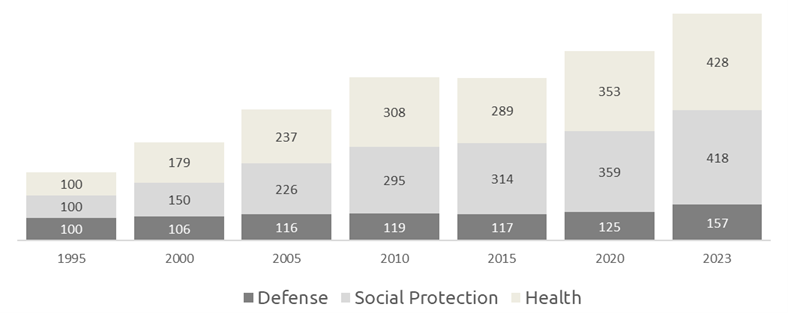
Source: INE. Author’s calculations.
Rethinking the Budgeting of Defence Investments
In a context that has become increasingly demanding for the defence sector, it seems necessary to rethink how defence expenditure is presented. First, to spend on defence, it is necessary to budget for defence. The new programme based budgeting process — or resource allocation process — implemented broadly in the 2026 State Budget requires alignment between budget programmes and the Government’s strategic priorities and goals, as set out in the Major Options. The link between allocated resources and expected results must be explicit (Article 6 of Decree Law No. 86/2025 of 18 July), namely through associated performance indicators and quantifiable targets.
It is particularly important to build on the ongoing reform and the legally established mechanisms to present a cross cutting Defence budget programme,[7] articulated with the LPM. This programme, which does not replace the existing ones, should capture all relevant expenditure and make visible the budgeted expenditure across different ministries (Organic Base Missions — OBM), such as the Defence OBM, as well as other sectors (other OBMs) that contribute to defence and security objectives — including the calculation of NATO Expenditure,[8] clarifying its dual use and financing sources, particularly following the Government’s commitment to reach a level of defence expenditure of 5% of GDP by 2035.
But the resource allocation process must not only provide transparency and visibility regarding major defence investment decisions. It must also analyse the full life cycle of equipment, which often extends over two or three decades, including development, acquisition, operation, maintenance and decommissioning. These long lasting assets require long term planning, and their costs must be fully integrated into decision making processes. Cost estimates related to the life cycle of military assets and their long term impacts can be found in other countries (defence oversight studies produced by several independent entities).[9]
The budgetary sustainability of the national defence strategy depends on the transparency and quality of the information shared with the public. A lack of information on its budgetary liabilities constitutes a structural risk to public policy, potentially undermining its legitimacy and effectiveness (Das, 2025). In the current context of shrinking fiscal space — shaped by the exhaustion of the “peace dividend” and increasing pressures on public expenditure — taking on long term financial commitments requires that communication about trade offs and the impact on future generations is not the last act in political decision making, but rather the first requirement for a responsible and sustainable fiscal trajectory. The national derogation clause may ease the application of fiscal rules, but it does not lessen the obligation to explain, justify, and remain accountable.
In the end, it is important to recall that public money is taxpayers’ money, who have the right to understand how they are used, what choices they entail, and what burdens they place on future generations.
[1] Through the European Commission’s communication of 9 September 2025, Portugal was allocated a provisional loan amount of €5,841,179,332.00 to be invested by 2030.
[2] https://defence-industry-space.ec.europa.eu/eu-defence-industry/safe-security-action-europe_en
[3] https://diariodarepublica.pt/dr/detalhe/resolucao-conselho-ministros/187-2025-958984037
[4] Using the military expenditure recorded in 2021 as the reference, under the defence functional classification in national accounts (Classification of Functions of Government).
[5] Furthermore, if the increase in defence expenditure results in a level of public debt above the level projected in the Medium‑Term Structural National Budget Plan (MTP) and in the absence of additional revenue or compensatory reductions in other expenditure, such a development may affect the fiscal adjustment requirements established in the next plan.
[6] For more information on the medium‑ and long‑term outlook, see the CFP Reports available at: https://www.cfp.pt/uploads/publicacoes_ficheiros/cfp-rel-07-2025_peo_25-29_atualizacao.pdf e https://www.cfp.pt/uploads/publicacoes_ficheiros/cfp-rel-11-2023.pdf
[7] A programme with common purposes.
[8] For different concepts of defence expenditure, see “So how much do we spend on defence?” (Marinheiro and Leal, 2025) available at: https://www.cfp.pt/en/blog/defence/how-much-is-actually-spent-on-defence
[9] For example, see the study carried out by the Office of the Parliamentary Budget Officer of Canada, available at: https://distribution-a617274656661637473.pbo-dpb.ca/34b45b0bb9aeeadfd2cc6ba7c6380521d6b4a051c21a87fd2b7dd51767323e89 or by the Congressional Budget Office available at https://www.cbo.gov/topics/defense-and-national-security.
References
Das, U. (2025, May 6). Failure to communicate is an economic policy risk. OMFIF. https://www.omfif.org/2025/05/failure-to-communicate-is-an-economic-policy-risk/
Dorn, F., Potrafke, N., & Schlepper, M. (2024). European defence spending in 2024 and beyond: How to provide security in an economically challenging environment (EconPol Policy Report No. 45). CESifo GmbH. https://www.econstor.eu/bitstream/10419/289556/1/1884156363.pdf
Office of the Parliamentary Budget Officer. (2023). The life cycle cost of Canada’s F-35 program: A fiscal analysis. https://www.pbo-dpb.ca/en/publications/RP-2223-019-S--life-cycle-cost-canada-f-35-program-fiscal-analysis--analyse-couts-cycle-vie-programme-canadien-f-35
Date of last update: 27/02/2026
About this Blog
Contraciclo is a forum for the views of the Portuguese Public Finance Council (CFP) staff and members on economic issues. The views expressed are those of the author(s) and do not necessarily represent the views of the CFP. Therefore, they cannot be attributed to the CFP or to the Senior Board under no circumstances.


