

 CFP
CFP
Demography, a relevant variable in Public Policies

Demographic trends and dynamics play an important role in the economic development of any country. The size and structure of the population impact the country's economic growth as well as its public finances, influencing its ability to develop and maintain essential policies such as social protection, access to healthcare, education, housing, just to highlight some of the areas that have been under pressure. Therefore, it seems justified to integrate demographic perspectives into the political framework for planning and designing public policies, just as with other fundamental variables, such as the availability of funding for these same policies. Viewing demography as a stage in the design of public policies is a way to adjust the policy to the projected evolution of its target audience, thus promoting greater effectiveness, or from a different perspective, it can enable shaping policy so that it results in a demographic evolution more favourable to the country's development.
Studying demographic trends is an increasingly key element for monitoring the evolution of societies and their sustainability, both economically and socially. By doing so, it quickly becomes clear that population aging is one of the most important and worrying demographic trends of recent decades.
Data shows that Portugal is already among the EU27 countries where the ageing process has manifested most sharply in the last decade. It is one of the three countries with the lowest percentage of population under 15 years of age (about 12.9% in 2023) and, together with Italy, it has the highest proportion of people over 65 years old (24% in 2023). This evolution leads to the estimate that Portugal will have the highest dependency ratio (ratio of elderly people aged 65 or over to the population aged 15-64) in the EU27: 38%.
This demographic evolution poses risks and opportunities for the country. On the risk side, the consequences of a shrinking active population on the labour market and the country's production capacity stand out. Given the weight of public revenues that depend on the labour market's performance in financing public policies, this evolution naturally poses challenges to the state's financing model and public policies, which will have to adapt to meet the needs of a transforming society. But it also presents a set of opportunities for activating underrepresented groups in the labour market, for greater investment in human capital throughout the life cycle, and for a serious commitment to innovative activities that can indeed increase productivity.
The demographic transition has transversal effects on public policies and, as such, must be addressed by a policy that is also transversal, coordinated, and informed by a long-term perspective. Towards this, it is essential to have high-quality statistics and population projections, anchoring the planning and development of policies at various levels of governance and adjusting the provision of public services and public investment to the needs of a changing population.
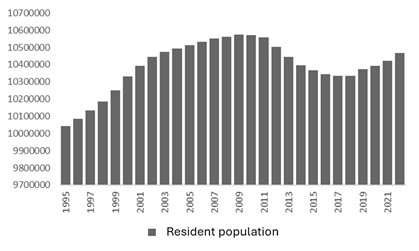
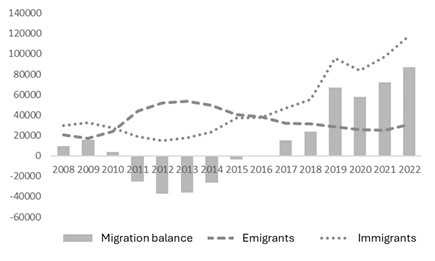
In this context, the analysis of the role of migrations in demographic evolution becomes inevitable. Immigration can create opportunities to increase the labour supply, but it can also, along with emigration, pose social and economic challenges. Statistical data shows the role that the migratory balance has played since 2017 (see graph) in the evolution of the Portuguese population, compensating the natural deficit that has been deteriorating since 2009 (despite a slight improvement in 2022). This balance also reflects the increase in migratory movements worldwide, a trend that has been accentuating, giving the issue of migrations greater prominence on the political agenda of many nations. [1]
1995 - 2022
2015 - 2022
Source: INE.
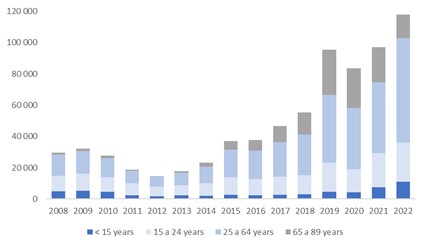
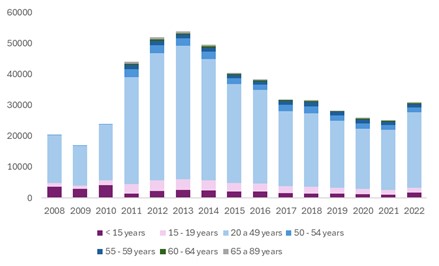
The increase in migratory flows is so far proving beneficial, helping to bolster the working-age population. But its impact on the country's productive capacity and public finances depends on its composition. To fully understand these dynamics, it is essential to closely monitor migration patterns, analysing the age, skills, and other relevant factors of both immigrants and emigrants and their impact on the population's evolution. By doing so, policymakers can ensure timely public policies that promote adequate incentives to attract and retain skilled workers in Portugal, whether they are nationals or immigrants, in a context where migratory dynamics are increasingly complex.
Immigration (2008 – 2022)
Emigration (2008 – 2022)
Source: INE.
The ongoing development of the Resident Population Base by the Statistics Office (INE), within the scope of the National Data Infrastructure, allowing the integration of administrative information from different public administration data sources, is a prime example of how to enhance the quality of data used for policymaking (knowledge for policy). However, addressing the demographic challenges involves more than just understanding population trends. It requires a comprehensive approach, integrating demographic factors into diverse policy domains and a medium-to-long-term perspective, requiring coordinated interventions across multiple levels of governance. Indeed, the management of migration flows is increasingly recognized as a crucial dimension to be integrated into regional, local, and sectoral policies, enabling a coherent approach to maximize benefits and mitigate potential adverse effects.[2]
Demographic projections for Portugal[3] for the coming decades point to a population reduction of about 14% between 2022 and 2070, reflecting, in the same time horizon, an increase of 20% in the population over 65 years of age.
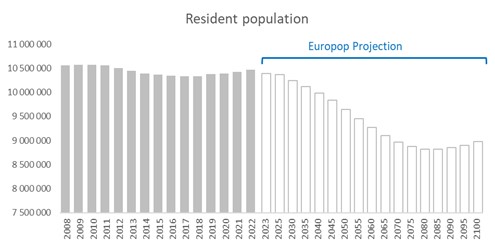
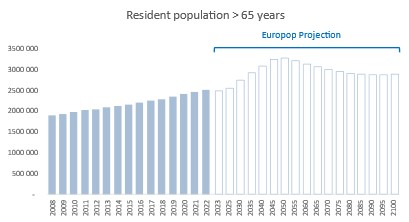
Source: INE and Eurostat
Despite their limitations, existing and historical demographic projections, coupled with empirical demographic data, constitute a valuable knowledge base for informing policy decisions. This information can be employed to evaluate the implications of future policies or alternative scenarios, particularly in domains such as pension systems, the labour market, and housing. While these projections do not purport to predict the future, they enable us to discern trends and their effects on citizens' well-being. These trends can be can be altered by numerous economic and social factors, including policies adopted by various levels of government.
Preparing the public sector for 21st-century challenges should also involves rethinking public policy instruments, promoting long-term strategic planning that defines national goals and the public policies needed to achieve them. This must be done while considering the role of demographics in shaping many of these challenges and selecting the appropriate policies to address them. It’s also important to remember that the future is shaped by our actions today.
[1] For recent developments in international migrations, see: https://www.oecd.org/migration/international-migration-outlook-1999124x.htm
[2] For more information, see: Integrating migration and development into labour market policies | Interrelations between Public Policies, Migration and Development | OECD iLibrary (oecd-ilibrary.org).
[3] Eurostat Projections (EUROPOP 2023)
Date of last update: 08/03/2024
About this Blog
Contraciclo is a forum for the views of the Portuguese Public Finance Council (CFP) staff and members on economic issues. The views expressed are those of the author(s) and do not necessarily represent the views of the CFP. Therefore, they cannot be attributed to the CFP or to the Senior Board under no circumstances.


