

 CFP
CFP
Pension Adjustment Model in Portugal: the Exception That Proves the Rule

The regular adjustment to pensions is an essential element of any pension system, public or private, due to its importance in guaranteeing the purchasing power of pensioners and its impact on the financial sustainability of the system. There are several models for adjusting pensions, which can range from indexing pensions to the variation of specific predetermined indicators to discretionary adjustments determined by governments at any given time. In Portugal, both models coexist. Since 2006, the annual adjustment of pensions in the social security system and the Caixa Geral de Aposentações (civil servants scheme) has been carried out following a rule created to provide predictability to the evolution of pension adjustments, from the perspective of both the pensioner and the system.[1] The rule was set in Law No. 53-B/2006, of December 29, with the amendments introduced by Decree-Law No. 187/2007 of May 10, determining different updates depending on the pension amount, taking into account the evolution of the following reference indicators:
a) Real GDP growth, corresponding to the average annual growth rate of the last two years, ending in the 3rd quarter of the year prior to the one to which the adjustment refers to, or in the immediately preceding quarter, if the former is not available by December 10;
b) Average change rate of the last 12 months of the CPI, excluding housing, available in December of the year prior to the one to which the adjustment refers, or on November 30, if the former is not available at the time the decree is signed.
The law provides three pension adjustment brackets based on the value of the Social Support Index (SSI). In the highest bracket, pensions equal to or greater than 12 times the SSI would only be updated in special situations, namely when their value, as a result of the P2 formula (which considers the complete contributory career[2]), is higher than the pension amount calculated based on the P1 formula (using the best 10 of the last 15 years) or if both calculations (P1 and P2) simultaneously lead to an amount above 12 SSI.[3]
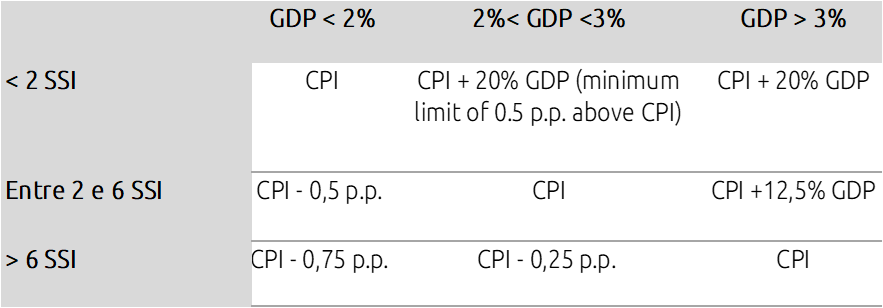
This rule provided for its reassessment every five years, with the first review scheduled by law to occur in 2012. Although it was never carried out, and perhaps because of this, the law has undergone occasional changes over time. In 2010, Article 7-A was added,[4] safeguarding the principle that the application of the rules cannot result in a decrease in the nominal value of pensions. In 2015, the reference month for the CPI indicator used in the adjustment was revised.[5] In 2016, the threshold of the first pension adjustment bracket was changed from 1.5 to 2 SSI, and in 2021, the safeguard clause provided for in Article 7-A was amended again, in order to freeze the SSI value of the previous year (and consequently the pensions) whenever the application of the SSI adjustment rules resulted in a negative change. [6]
Between 2008 and 2023 (16 years), the pension indexation rule was applied in 8 years and suspended in the remaining 8.[7] In 5 of the 8 years in which the rule was followed, it was complemented by a model of extraordinary updates, following a completely different logic: while the indexation rule stipulated in Law No. 53-B/2006 applies based on the value of each pension, the extraordinary updates that occurred between 2017 and 2022 were granted to the pensioner as long as a condition related to the total value of the pensions they receive was met, meaning these were updates per pensioner.[8] This change led to the creation of a specific pension supplement, independent of the other main pensions, which has also become subject to annual adjustments according to the rule.[9] Another distinctive feature of the extraordinary updates was that they were granted in absolute terms (6 or 10 euros), with the differentiation in the update depending on whether the pensioner had received at least one updated pension between 2011 and 2015. In 2022, the extraordinary update per pensioner was 10 euros, without differentiation as in previous years.[10],[11] The annual pensions update according to the indexation rule was deducted from these extraordinary adjustments.
The graph shows an example of the evolution of these two types of adjustments.
Minimum Pension (career > 31 years)
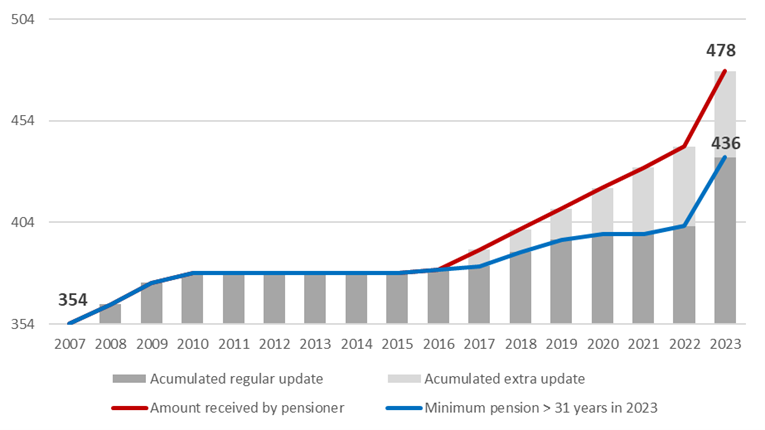
Notes: Example of a pensioner without pension updates between 2011 and 2015, but entitled to an extra payment of €10. The 50% pension bonus from October 2022 is not included. The 2023 interim update was reflected in the regular pension update.| Source: Author's calculations.
In September, a new exceptional supplement for pensioners was created through Decree-Law No. 57-C/2022, of September 6th, to offset the rising cost of living. This payment was equal to 50% of the total pension received in October 2022. At the same time, the usual pension update rule was suspended for 2023 by Law No. 19/2022, of October 21st. A new, temporary update system was put in place, in its article 5th, which maintained the differentiation by pension bracket but applied lower update rates than those resulting from Law No. 53-B/2006. However, due to higher-than-expected inflation in 2022, the pension update provided for in Law No. 19/2022 was corrected by Decree-Law No. 24-B/2023, of January 9th, as provided for in article 87 of the 2023 State Budget Law, establishing new values for the regular pension updates to be in effect from January 1st, 2023:
a) 4.83% for pensions up to 2 SSI;
b) 4.49% for pensions between 2 and 6 SSI;
c) 3.89% for pensions between 6 and 12 SSI.
According to figures released by the government, the special payment planned in October, combined with a regular update in January 2023, would ensure that all pensioners would end the year with the same amount they would have received if the usual pension update rule had not been suspended. Decree-Law No. 28/2023, of April 28th, determined an additional 3.57% increase in pensions due from July 2023 onwards, applicable to pensions up to 12 SSI (€5,765). This extra update, materialized in Ordinance No. 172/2023, of June 23rd, restored the amount pensioners would have received under the old rule, provided by Law No. 53-B/2006, if it had not been suspended by Ordinance No. 24-B/2023, of January 9th. 16 years of applying the pension indexation rule demonstrates that, in fact, there is no rule without exceptions, and in this case, many. In 2023, the exception in the form of an extraordinary update ended up confirming the rule.
[1] In compliance with article 42 of Decree-Law No 187/2007 of May 10.
[2] For detail see articles 32, 33 and 34 of Decree-Law No 187/2007 in its current version.
[3] The limitation to the adjustment principle provided for in Law No. 53-B/2006, of December 29, was introduced by Article 101 of Decree-Law No. 187/2007, of May 10.
[4] Law No 3-B/2010, October 28.
[5] Decree-Law No 254-B/2015, December 31.
[6] Decree-Law No 16-A/2021, February 25.
[7] The rule is considered to have been complied with in the years in which the respective Pension Update Ordinance was published, based on the brackets and indicators provided for in Law No. 53-B/2006: Ordinance No. 9/2008, of January 3; Ordinance No. 1514/2008, of December 24; Ordinance No. 65/2016, of April 1; Ordinance No. 98/2017, of March 7; Ordinance No. 23/2018, of January 18; Ordinance No. 25/2019, of January 17; Ordinance No. 28/2020, of January 31; Ordinance No. 301/2021, of December 15.
[8] Only pensions from the social security system and the convergent social protection scheme (paid by the Caixa Geral de Aposentações) are relevant for this adjustment.
Date of last update: 14/07/2023
About this Blog
Contraciclo is a forum for the views of the Portuguese Public Finance Council (CFP) staff and members on economic issues. The views expressed are those of the author(s) and do not necessarily represent the views of the CFP. Therefore, they cannot be attributed to the CFP or to the Senior Board under no circumstances.

Related Articles
 Social Protection . 07 April 2026

