

 CFP
CFP
Fiscal restraint instruments: how were they managed in 2025?

Currently, a significant part of the discretionary power held by the Minister of Finance and sectoral ministers over the use of fiscal resources is exercised through a wide range of fiscal control instruments at their disposal, which enable them to monitor budget implementation throughout the year. This article examines the management of the following instruments in 2025: freezing of appropriations, the budgetary reserve, the provisional appropriation and the centralised appropriations.[1] The figures are presented in cash basis accounting and correspond solely to actual expenditure, as discussed in the article ‘Expenditure control instruments: how have they been managed by the Ministry of Finance?’.
Freezing of appropriations
The initial and additional freezing applied to central government’s actual expenditure appropriations for 2025 have increased substantially compared with 2024. Freezing of appropriations corresponds to the retention of a portion of the expenditure appropriations of central government departments and bodies, with the aim of ensuring flexible control over fiscal implementation. In 2025, this restricted use of budgetary appropriations was established in Article 3 of the 2025 State Budget Law. Subsequently, under Article 6 of the Fiscal Implementation Decree-Law, published in March 2025, additional freezing was applied to compensation of employees and acquisition of goods and services appropriations, as well as to ‘other current expenditure’ and transfers to outside of general government. According to information published by the Budgetary Entity in the 2025 General State Account (CGE/2025), the consolidated total of initial freezing of actual expenditure appropriations of central government departments and bodies for 2025 amounted to €3,155.5 million, to which were added further freezing applied during the course of fiscal implementation amounting to €81.8 million, totaling €3,237.2 million. This was more than double the amount applied under the State Budget for 2024 (SB/2024) (€1,258.2 million), with the increase being largely attributable to the programmes of Infrastructure (particularly in the projects of the respective SOEs included in general government), Defence (mainly under the chapter ‘Government Action and Central Support Services’) and Finance (particularly under ‘Chapter 60 – Exceptional Expenditure’). In cash basis accounting, the share of freezing funds in the total actual expenditure allocation of central government rose from 1.4% in 2024 to 3.2% in 2025.
Table 1 – Management of central government freezing expenditure in 2025 (M€)
.png)
Source: MoF (CGE/2025). Author’s calculations. | Notes: includes freezing of the budgetary reserve; consolidated figures, except those relating to the use of unfreezing (which explains why the total for these is higher than that for unfreezing); no application of unfreezing of the budgetary reserve was considered as this information is not available; the initial freezing result from the application of Article 3 of Law No. 45-A/2024 of 31 December and Article 6 of Decree-Law No. 13-A/2025 of 10 March, and include freezing relating to expenditure growth in the following categories: compensation of employees (€288.1 million), acquisition of goods and services (€769.8 million), current transfers outside general government (€95.4 million), other current expenditure (€230.8 million) and capital transfers outside general government (€98.2 million); additional freezing were applied during the course of fiscal implementation, in accordance with Article 3(10) of the 2025 State Budget Law and Article 6 of the Decree-Law on Fiscal Implementation for 2025; during fiscal implementation, transactions relating to other fiscal management operations and/or carried out improperly took place, as well as the respective corrections, representing records of freezing of around €1 million and records of unfreezing of around €1.9 million.
In 2025, final freezing of central government expenditure reached the highest level since 2016, but as a percentage of initial freezing, the ratio was lower than recorded in recent years. Of the total of €3,237 million in initial and additional freezing funds, €2,434 million was released during 2025, more than half of which was spent on the acquisition of goods and services. Final freeze funds totaled €803 million, the highest amount since the €941 million recorded in 2016, contrasting with the average of €468 million observed over the period 2017–2024. Regarding these final freeze funds, the following is also noted:
-
Almost 30% corresponded to freezing in the ‘Infrastructure and Housing’ programme;
-
They related mainly to the items ‘acquisition of goods and services’ (€217.3 million) and ‘other current expenditure’ (€382 million, of which €261.3 million was from the budgetary reserve);
-
They increased by €322 million compared with 2024 (left-hand panel of Chart 1);
-
They accounted for 24.8% of total initial and additional freezing, a percentage influenced by the sharp rise in the value of the denominator (right-hand panel of Chart 1).
Chart 1 – Management of expenditure freezing in the period 2015–2025
| Initial freezing* vs. Final freezing (M€) | Proportion of final freezing funds relative to initial freezing funds* (%) |
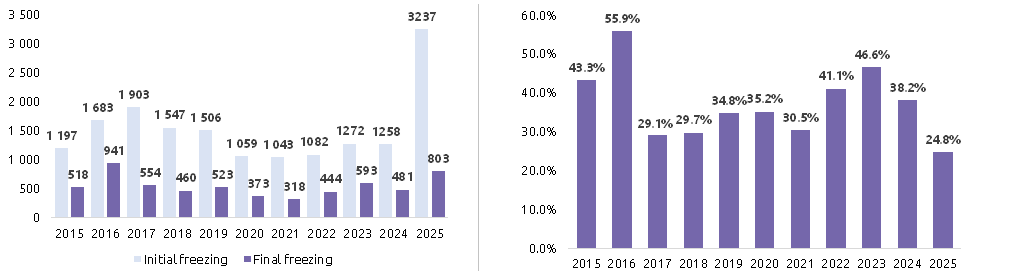
Source: MoF (General State Accounts). Author’s calculations. | Notes: consolidated figures; includes the budgetary reserve and excludes financial assets and liabilities; (*) the total initial freezing include additional freezing made during fiscal implementation; the weight of final freezing corresponds to their weight in the total of initial and additional freezing.
Budgetary reserve
More than half of the budgetary reserve was not utilised in 2025. The budgetary reserve for 2025 totalled €591.1 million (of which €460 million was freeze from the very beginning), a figure corresponding to 2.5% of the expenditure budget of each central government budgetary programme, in accordance with DGO Circular No. 1410. Of this total, €273.6 million was utilised, representing 46.3% of the available reserve. Almost three-quarters of this utilisation was accounted by the Ministry of Defence (€57.8 million), the Ministry of Internal Affairs (€51.8 million, mostly to reinforce the budget of its General Secretariat), the Ministry of Education, Science and Innovation (€50.4 million) and the Ministry of Justice (€43.3 million, of which €32.2 million was to reinforce the budget of the Institute for Financial Management and Justice Equipment). In terms of functional classification, the bulk of the utilised expenditure was related to ‘Economic affairs’ (€166.7 million, of which €74 million on transport). Consequently, €317.5 million remained unspent, corresponding to just over half of the budgetary reserve, primarily because €261.3 million had not been unfreeze in the first place.
Provisional appropriation
The provisional appropriation was used almost in its entirety, primarily to reinforce compensation of employees of the Ministry of Education. This appropriation is intended to cover unforeseeable and urgent expenditure, in accordance with Article 45(11) of the Fiscal Framework Law. The use of this appropriation may only be authorised on an exceptional basis by the Minister of Finance. Throughout 2025, as funding needs were identified, the provisional appropriation was gradually annulled against increases in various expenditure items. The provisional appropriation for 2025 totalled €500 million, with expenditure applicated against the use of this appropriation amounting to €422.7 million. Approximately 96% of the amount used was allocated to increasing compensation of employees. The main beneficiary was the Ministry of Education, which received €240.9 million to ensure the payment of all staff costs, particularly those relating to teaching staff, notably those arising from changes in remuneration positioning and from the recognition of teaching staff’s length of service. To a lesser extent, reinforcements were recorded in the Ministry of Internal Administration (€75.6 million, of which €49.4 million for the PSP and €26.2 million for the GNR) and in the Ministry of Justice (€72.3 million, of which €67.4 million for the Directorate-General for the Administration of Justice).
Centralised appropriations
The centralised appropriation ‘Settlement of liabilities and investment in financial assets of the central administration’ resulted in actual expenditure exceeding the forecast. Centralised expenditure appropriations within the Ministry of Finance with an impact on actual expenditure amounted to €225 million in the 2025 State Budget. The appropriation relating to the overall national public contribution (€50 million) was fully used, whilst the appropriation for Portugal’s participatory budget (€5 million) was not used. The appropriation earmarked for the management of liability settlement operations and investment in central government financial assets totalled €1,278.9 million, of which €170 million was actual expenditure and €1,108.9 million was non-actual expenditure (financial assets). Budgetary reinforcements with a counterpart in this centralised allocation amounted to €263.4 million, of which €216.9 million was allocated to actual expenditure – meaning that a portion (€46.9 million) of this centralised allocation, which had been recorded as non-actual expenditure, was subsequently allocated to actual expenditure. It is worth mentioning the allocation to capital transfers (€71.6 million), mainly for the implementation of projects by the Foundation for Science and Technology (€47 million). Also of note is the allocation to the acquisition of goods and services (€58.9 million), mainly in primary and secondary education establishments: €38.8 million, to cover the costs arising from the programme contract concluded between the Portuguese State and Construção Pública, E.P.E. Thus, for centralised appropriations as a whole, actual expenditure amounted to €266.9 million, exceeding the €225 million initially forecast.
Conclusion
In 2025, of the total available €4,018.8 million in actual expenditure relating to fiscal restraint instruments, €894.8 million (0.3% of GDP) remained unspent. This unspent amount, corresponding to 22.3% of the initial appropriation, resulted from factors of different nature. On the one hand, €936.7 million was not spent due to: i) unfreeze funds (excluding the budgetary reserve) amounting to €541.9 million; ii) the non-utilisation of the budgetary reserve (€317.5 million) and the provisional appropriation (€77.3 million). On the other hand, the appropriations centralised at the Ministry of Finance (MF) saw actual expenditure that was €41.9 million higher than forecast in the 2025 State Budget. Of the total €4,018.8 million available for 2025, €3,124 million were used, reflecting a utilisation rate of 77.7 per cent. Despite the possible increase in the bureaucratic burden associated with these instruments, the available data does not allow us to conclude whether this resulted in greater effectiveness in containing public expenditure.
Table 2 – Management of fiscal restraint instruments in 2025 (in M€)
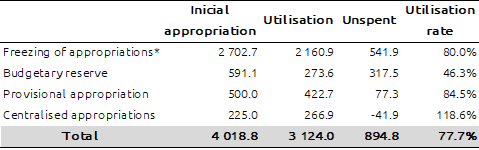
Source: MoF (CGE/2025). Author’s calculations. | Note: (*) does not include unfreezing of the budgetary reserve (and for this reason this total for freezing is not comparable with that shown in Table 1),but includes additional freezing applied during fiscal implementation; includes only actual expenditure.
[1] It is also worth noting the available funds regime which, although not usually considered part of the range of fiscal restraint instruments, has in practice served that purpose in recent years.
Date of last update: 17/07/2026
About this Blog
Contraciclo is a forum for the views of the Portuguese Public Finance Council (CFP) staff and members on economic issues. The views expressed are those of the author(s) and do not necessarily represent the views of the CFP. Therefore, they cannot be attributed to the CFP or to the Senior Board under no circumstances.

Related Articles
 Fiscal policy . 01 February 2021

