

 CFP
CFP
The institutional framework of Portuguese public finances: current situation and short-term outlook

A brief overview of the new framework of fiscal rules after 2024
In April 2024, the new European economic governance framework came into force, comprising two regulations that embody the so-called preventive and corrective arms of the Stability and Growth Pact (SGP) – Regulations 2024/1263 and 2024/1264 of 29 April – as well as a directive, Directive 2024/1265 of the same date, which sets out the requirements applicable to Member States’ fiscal frameworks, amending a previous directive from 2011.
Whereas, under the previous legal framework, in addition to the rules of the Treaty on the Functioning of the European Union (TFEU) regarding the nominal balance and the public debt-to-GDP ratio, the structural balance rule prevailed – this being expressed through a specific ‘medium-term objective’ for each country, depending on the public debt ratio presented – now, under the new framework, linked to a medium-term objective of controlling the trajectory of the public debt-to-GDP ratio, a new key indicator has emerged (although it is doubtful whether this can be considered a true fiscal rule), namely the indicator of net government expenditure.
This indicator bears some similarities to the previous expenditure benchmark, enshrined in the Stability and Growth Pact following the 2011 revision. However, it has different characteristics both in its determination and in its assessment.
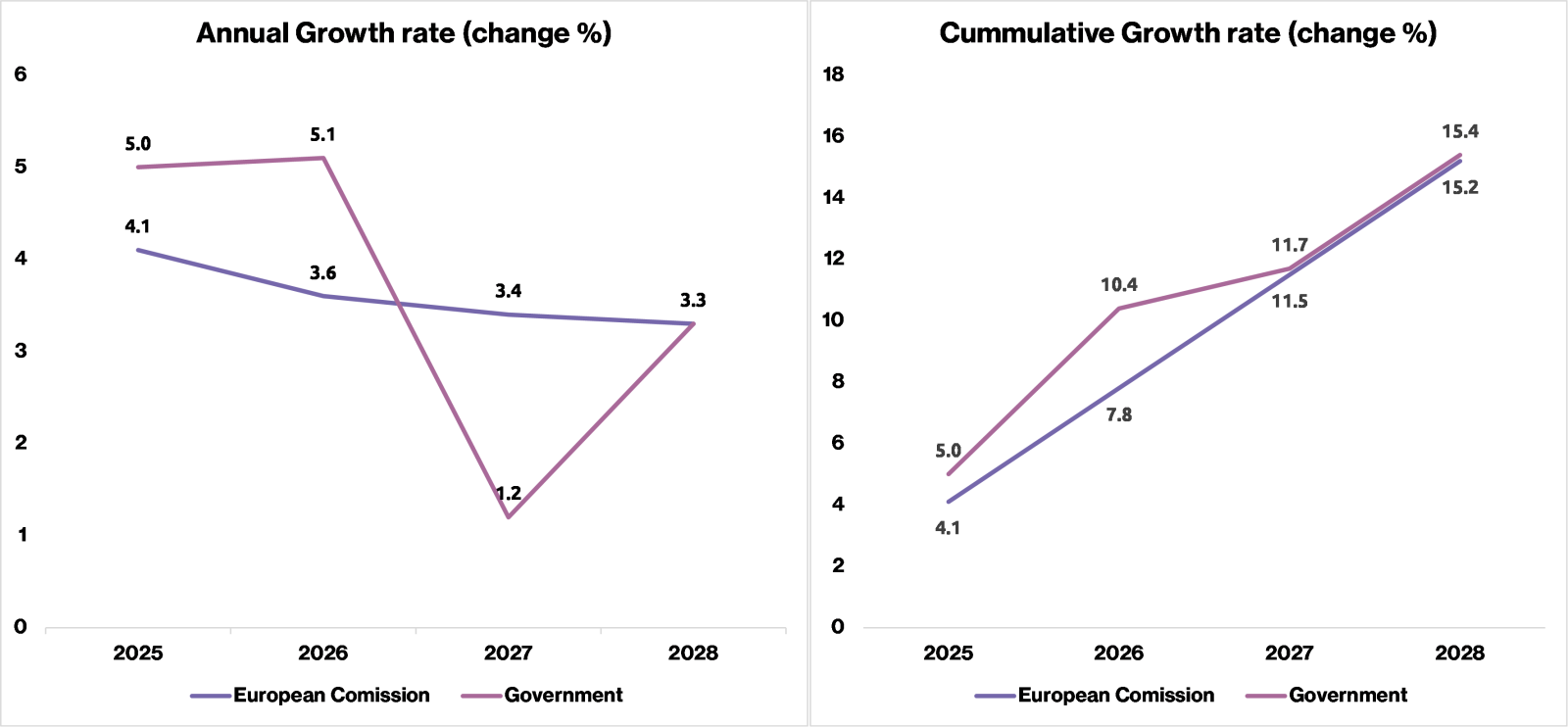
In its determination, because whilst, under the previous regime, the limit on the annual variation in expenditure was set in European legislation itself, using the average growth rate of potential output over ten years as a reference, now, under the new regime, it is up to governments, in their national medium-term fiscal-structural plans, MTP (to be approved by the Council of the European Union), to set the trajectory of net expenditure for the four- or seven-year period covered by them; this trajectory must, in turn, take into account the reference trajectory initially set by the European Commission (EC) and, should it deviate significantly from it, provide solid justifications for that difference. In the case of the Portuguese MTP for the period 2025–28, presented by the government in October 2024, analysed by the CFP on that date, and approved by the Council the following January, the average annual growth rate of net expenditure, set at 3.6%, coincides with the reference path communicated by the EC to the Portuguese authorities in June 2024, although the year-on-year profile committed to by the Government is different: a higher rate of growth in net expenditure in the first two years of the plan (2025 and 2026), a significantly lower rate of growth in the third (2027), and in line with the Commission in the final year (2028) – see Chart 1.
Chart 1 – Net expenditure trajectory 2025–2028
Source: MF and EC.
However, there are also differences regarding the assessment of compliance compared to the previous expenditure framework, as the new regime provides for the creation, by the EC, of an innovative ‘control account’ designed to record, on an annual basis, positive or negative deviations in net expenditure from the commitments set out in the plan. This account will be created in May 2026. This record allows for a comparison of the growth rate of net expenditure not only in each year, but also against the cumulative growth rate throughout the plan’s implementation (in this case, over the four years). Only at the end of the plan’s implementation, in this case after 2028, and once all deviations have been accounted for, will it be possible to verify whether, cumulatively, the growth rate corresponded to that initially forecast and, ultimately, to determine whether the average growth rate of net expenditure complied with the commitment made.
In the event of a positive deviation exceeding 0.3% of GDP on an annual basis or 0.6% of GDP on a cumulative basis, where the public debt-to-GDP ratio exceeds the Treaty’s reference value, an excessive deficit procedure (EDP) may be initiated. This will not be the case, however, if the fiscal balance for the year in question is in balance or close to balance (i.e. a deficit of less than 0.5% of GDP). Nor will this be the case if the provided-for derogation clauses are invoked, which may be of a general nature or specific to a particular country.
The net expenditure indicator refers to primary expenditure excluding one-off measures; it excludes not only expenditure financed by European funds and/or with national co-financing, but also the cyclical component of expenditure on unemployment benefits, and includes changes in public revenue—particularly tax revenue—of a discretionary nature (i.e. those not determined by the economic cycle)[1] Two common difficulties arise here: i) regarding the cyclical component of unemployment expenditure, one must start from the non-cyclical component by approximating the concept of structural unemployment, as defined by the NAWRU (Non-Accelerating Wage Rate of Unemployment) – a non-observable variable which, as such, entails its own problems of determination; ii) methodological difficulties persist with regard to discretionary revenue measures (DRMs), largely resulting from the absence, to date, of clear and sufficient criteria for their estimation (to be defined, first and foremost, by the EC).
The net expenditure indicator also merits consideration in light of the incentives it provides to the fiscal decision-maker. As it is relatively agnostic regarding the model of the state and the size of the public sector in the economy, it allows for fiscal consolidation based on measures to control and contain the growth of public expenditure or on discretionary decisions on the revenue side (namely those entailing an increase in the tax burden). Each country can thus, taking into account the pre-existing size of its state (including the size of the fiscal state), use this agnosticism in the approved legislation to, within the framework of its own policy choices, calibrate the key variables of fiscal adjustment, with a view to maintaining its public debt at sustainable levels.
Recently, the CFP published its opinion on the 2026 Annual Progress Report, in which it concluded that the rate of growth in net expenditure calculated by the CFP for 2025 shows a deviation from the commitment made by the Portuguese State that does not lead to the opening of an EDP. “In cumulative terms, taking 2023 as the base year, the CFP calculates that net expenditure increased by 19% in 2025, exceeding the maximum cumulative growth rate of 17.4% agreed with the Council of the EU. This excess translates into a cumulative deviation of 0.5% of GDP, which is below the maximum cumulative threshold of 0.6% of GDP.”[2]
And what is the impact of defence expenditure on the change in the State’s net expenditure?
In March 2025, the European Commission proposed the coordinated activation of the national derogation clause to accommodate the increase in defence expenditure.[3] This clause was activated for Portugal in July of the same year. During each year in which the clause is active (between 2025 and 2028), Member States may increase their defence expenditure by up to 1.5% of GDP, calculated in relation to increases in defence expenditure since 2021. In this case, for the purposes of determining any deviations from the State’s assumed net expenditure, Member States will benefit from the so-called ‘enhanced control account’.
In 2021, according to national accounts, Portugal spent around €1.7 billion on defence, equivalent to 0.8% of GDP. Consequently, as there is scope to increase defence spending by a further 1.5% of GDP, Portugal could reach 2.3% of GDP in any of these years. However, it does not appear that Portugal intends, at least for the time being, to make full use of this margin of flexibility. Between 2021 and 2025, defence expenditure stabilised at around 0.8% of GDP, according to data reported by INE in accordance with the COFOG classification.[4] This translates to zero growth in this expenditure; consequently, the CFP considered that, for 2025, this expenditure would have no effect on the augmented control account. On the other hand, for 2026, the forecast for defence expenditure underlying the State Budget in national accounts stood at €3.9 billion (1.21% of GDP). This forecast has now been revised downwards in the 2026 Annual Progress Report submitted to the EC, to around €3.3 billion (equivalent to 1% of GDP), which means, compared to that initial figure of 0.8% of GDP, an increase of 0.2 percentage points of GDP. Implementation figures for the current year will confirm whether even these reduced figures will be met or not.
Conclusion
As we have seen, the commitment made in the Portuguese MTP contains what we might call a ‘backloaded’ approach, in which the effort to contain net expenditure growth is eased in the early years of the plan and then tightened in the later years (see Chart 1). On the other hand, in the report “Macroeconomic and Fiscal Outlook 2026–2030”, published last April, the CFP presents a projection for net expenditure growth for the years 2027 and 2028, the last two years covered by the MTP, anticipating growth in this indicator significantly higher than that assumed by the Government in that Plan (in 2027, 3.9% instead of the 1.2% assumed in the Plan, and in 2028, 4.1% instead of the 3.3% assumed in the Plan). This no-policy-change projection suggests that the coming years will bring increased demands and some potential dilemmas, both for the execution of public expenditure and for policy decisions regarding revenue, given their impact on the tax burden.
[1] It should be noted that, in the light of this indicator and all other factors remaining constant, any policy measure that leads to an increase in tax revenue implies a reduction in net expenditure, and vice versa.
[2] Available here Opinion on the Annual Progress Report 2026.
[3] See, on this subject, the papers by Marinheiro and Leal (2025) (available here: How much is actually spent on defence?) and by Goulart (2026) (available here: How much will we end up spending on defence?).
[4] Acronym for “Classification of the Functions of Government” (traditionally known in Portugal as the functional classification) – reported in national accounts.
*Article originally published in the Eco newspaper on 28 May 2026.
Date of last update: 29/05/2026
About this Blog
Contraciclo is a forum for the views of the Portuguese Public Finance Council (CFP) staff and members on economic issues. The views expressed are those of the author(s) and do not necessarily represent the views of the CFP. Therefore, they cannot be attributed to the CFP or to the Senior Board under no circumstances.

Related Articles
 Fiscal policy . 15 May 2024

