Calendar
 Newsletter


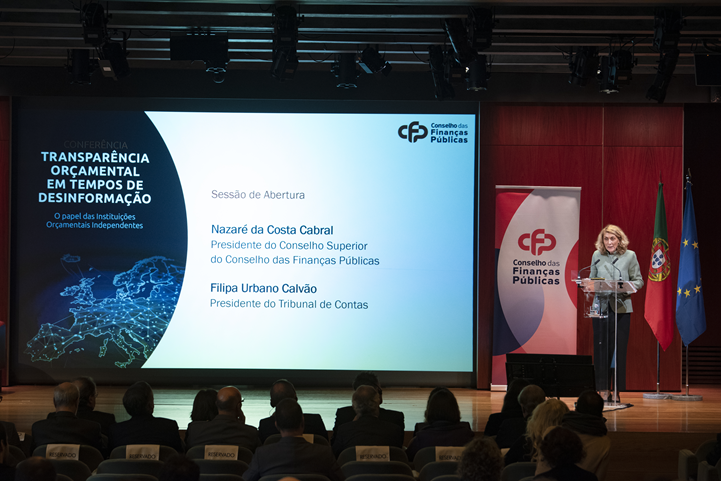
Speech by the Chair of the Portuguese Public Finance Council, Nazaré da Costa Cabral, at the opening of the conference "Fiscal transparency in times of misinformation: the role of Independent Fiscal Institutions", organised by the CFP on 24 February 2026 at the Calouste Gulbenkian Foundation.
The Portuguese Public Finance Council is 14 years old: it is alive and well and highly recommended
Mr President of the Constitutional Court, Professor José João Abrantes
Madam President of the Court of Auditors, Professor Filipa Urbano Calvão
Major General Aquilino Torrado, representing the Chief of Staff of the Army, General Eduardo Mendes Ferrão
Honourable Members of the Assembly of the Republic
Honourable Judges of the Court of Auditors
Members of the Courts of Appeal present here
Senior officials of the Public Administration and the Armed Forces present or represented here.
Ladies and gentlemen.
I would like to begin by thanking everyone for their presence, especially our speakers and moderators – it is an honour for the CFP to have you here this morning. I believe this will be a very fruitful working session, allowing us to reflect on the current economic and public finance context, the short- and medium-term outlook, and the role that independent fiscal institutions can play in this context.
This conference has been organised to mark the 14th anniversary of the Portuguese Public Finance Council, which took place on 16 February. Although the Portuguese Public Finance Council (CFP) was created during a process that began in 2010, internally, 16 February 2012 was set as the official date of its 'birth', the date on which the members of the Senior Board, led at the time by Dr Teodora Cardoso, took office for the first time. Prior to that, its Statutes had been approved by law of the Assembly of the Republic (Law No. 54/2011 of 19 October, since amended, the articles of which we will refer to here).
The CFP is an independent administrative entity, endowed with administrative and financial autonomy and its own assets, subject to the regime of autonomous services and funds (Article 1). The ambivalence of its nature – being both administrative and independent – is not always easy to manage and interpret, since although the CFP is a public entity, the elements the elements of 'flight to private law' – as is the case, for example, in labour matters – confront us daily with the need to balance bureaucratic requirements with management flexibility, a balancing act that often confronts us with legal uncertainty or volatility.
However, the structuring principle of the CFP, enshrined in both national and European law, is the principle of independence. This means that ‘the council and the members of its respective bodies act independently in the performance of the functions assigned to them by law and by these statutes, and may not request or receive instructions from the Assembly of the Republic (AR), the Government or any other public or private entities’ (Article 5). Guarantees of independence include, first and foremost, the process of selecting the members of the Senior Board (the highest decision-making body), as they must be "persons of recognised merit, with experience in the areas of economics and public finance and a high degree of independence" (Article 12). In addition, the names are jointly proposed by the President of the Court of Auditors and the Governor of the Bank of Portugal, who are themselves independent entities vis-à-vis the government and other bodies. Further guarantees of independence, reinforced in current European legislation on economic governance, are the sufficiency of resources for the pursuit of their activities and their stability over time.
As already mentioned, the CFP is part of the so-called Independent Fiscal Institutions (IFIs), which are part of the main European and international networks that bring these institutions together. Currently, all EU countries have an IFI, including Poland, a country that was lacking one until 2026. The CFP also has links with the European Fiscal Board, which monitors the budgetary situation of EU countries and is represented here today by its President, Pieter Hasekamp, who will be one of the speakers at the conference. Last but not least, the CFP has close relations with various entities in the area of public finance, especially in Portuguese-speaking countries, Brazil, African countries and East Timor, promoting good practices and formally signing, a cooperation protocol with our counterpart in Cape Verde, with a view to developing the latter's technical capacity and with a view to working together in the future.
The CFP has a broad mandate, which results primarily from these same European legal requirements (reiterated with the recent approval of Regulation (EU) 2024/1263 and Directive (EU) 2024/1265), but this mandate also results from the choice of the domestic legislator . Its powers include, first and foremost, endorsing the macroeconomic forecasts prepared by the government and underlying the main fiscal documents (first and foremost, the State budget itself), as well as analysing those same documents and assessing compliance with fiscal rules – which, at present, following the aforementioned revision of the European framework, are essentially reflected in the benchmark for net state expenditure and monitoring of the public debt ratio. In addition, the CFP assesses not only the fiscal execution of the State sector, but also the financial situation of various institutional subsectors – an aspect that we have been expanding over time – including social security, regional and local sectors, health and State-Owned Enterprises. Last but not least, the CFP conducts a risk analysis of Portuguese public finances and assesses their medium- to long-term sustainability.
As a result of the ongoing revision of the Fiscal Framework Law (LEO), it is to be expected that both the mandate and the guarantees of independence of the CFP will be made explicit and, in our view, strengthened. A critical aspect of the revision of this law, as well as the amendment to the financial laws of local authorities and autonomous regions (also in progress), is the unequivocal confirmation of the CFP's role in monitoring the fiscal rules applicable to these sectors and the importance of ensuring consistency between these and the fiscal rules to be defined for the State as a whole, whether they are imposed by Europe or are of national origin - if it is decided to establish national fiscal rules, as we have argued. This defence of national fiscal rules is now all the more pressing, as the European framework of rules appears to us to be somewhat weakened.
It is also important, in order to strengthen the independence of the institution, to enshrine in law (including in the CFP Statutes) the prior parliamentary hearing of the candidates proposed for the CFP's Senior Board, thus involving the Assembly of the Republic in the process of selecting these members, as is the case with regulatory bodies. This will certainly be an additional factor in enhancing the credibility of those appointed to these positions. In this regard, it is important to recall the recommendation made by the OECD in its 2019 assessment of the CFP, which suggested precisely this involvement. I believe that, at this moment, with the legislative process underway, the conditions are finally in place to implement this recommendation in our law very soon.
Also crucial, within the framework of this ongoing legislative review, is the strengthening of fiscal transparency, a critical element for the quality and accuracy of the CFP's work, namely access to relevant financial (and other) data and information. There is also an urgent need for a 'cultural' change on the part of public entities obliged to provide information to the CFP, so that they understand that providing this information is a legal obligation and not a matter of discretion, once data protection requirements have been safeguarded.
Fourteen years after its 'official' creation, the CFP is doing well and is highly recommended. It has become a national benchmark institution, whose brand images are quality, rigour and impartiality. It owes this to its few but excellent employees. This aspect deserves to be highlighted: here too, as has been the case in other areas of the State and the private sector, the CFP will only be able to attract and retain talent if it has salary instruments that recognise that talent, which implies a remuneration review to be decided by those with the authority to do so, without prejudice to other valuation instruments that the institution has promoted internally to the extent of its legal and financial possibilities.
Allow me, at this point, to take the opportunity to give a brief and necessarily incomplete account of my term as head of the CFP over the last seven years, i.e. for almost half of its existence, and since this term is coming to an end. In any case, I would like to begin by pointing out that the new European Directive, already mentioned here, also requires external and independent evaluation of IFIs. In this regard, I believe that, once this evaluation requirement is enshrined in our domestic legislation, the CFP will be able to promote it as soon as it deems it appropriate and feasible (because, as we know, evaluation processes are also time-consuming and resource-intensive, and demanding). The last and only evaluation of the CFP, carried out by the OECD, was the one mentioned in 2019 (Scherie Nicol is here with us today and led that process at the time, which also included Professor António Afonso, who is also here today).
This brief report that I will now give is accompanied by some reflections on the challenges and constraints that I believe the CFP, like other IFIs, will face in the near future. When I took up my duties in March 2019, I set myself a number of objectives that I would like to see achieved, namely: on the one hand, general policy objectives for the institution; on the other, technical objectives, the latter being drawn up or guided after becoming more aware of the CFP's mission and responsibilities.
As for the institution's general policy objectives, my first major goal was to safeguard and strengthen its independence, protecting it from political party confrontation and its exploitation by any type of interest or opportunistic agenda other than the fulfilment of its mission, which is a mission of public interest. The CFP's mission is to ensure the sustainability of Portuguese public finances within the framework of an economy that aims to be based on equally sustainable growth.
The institution's second general policy objective was to help dispel certain misconceptions and outdated perceptions in the general public, namely the association of the CFP with two ideas: on the one hand, the CFP as a creation or creature of the so-called 'Troika'; on the other hand, the CFP as an institution imposed by the European Union but uprooted from the country. These two ideas, I believe, have gradually been corrected. At present, I believe that the CFP is a national institution that is correctly perceived as the entity responsible for monitoring and supervising our public finances, with the important role of providing early warning of the main risks that may affect the future development of those same public finances. The national ownership of the institution seems to me to be unequivocal today, as it is considered a credible institution and respected by citizens in general.
On the other hand, the CFP is aware of the limits of its action, of what it is legitimate for it to do and what it cannot do. I recall a 2008 article by Charles Wyplosz on Independent Fiscal Institutions (IFIs) (in particular, fiscal councils such as the CFP). In that article, the author stated that the intervention of these institutions should be limited to the macroeconomic role of fiscal policy, excluding the microeconomic aspects of that policy. In other words, it would not be appropriate for IFIs to interfere in resource allocation and redistributive choices, as these choices are the sole responsibility of elected politicians, who are the only ones accountable to voters. The boundary of legitimacy for intervening or making recommendations is, in fact, a fine line that must be navigated with caution and common sense: while it is true that IFIs should have considerable freedom and capacity for analysis and research at a theoretical and empirical level on a wide range of issues related to fiscal policy, including the micro impacts of public policies, this should not be confused or interpreted as an attempt to override or influence political power, particularly in choices regarding the allocation and redistribution of resources. At the CFP, we have tried, and I have personally sought to do so, to strike a good balance between making the most of the possibilities offered by our mandate and respecting its limits. Only this balance is healthy because it preserves institutional legitimacy.
The CFP aims to be a voice that is heard by the general public and political leaders in particular. I believe that important steps have been taken in this direction, but there is room for growth in the future. Communication with the public, through the press and social media, is an area that deserves our attention and priority, but also some concern. Given the technical nature of their work, IFIs must always combine the necessary media exposure with the renunciation of speculative or sensationalist temptations. In a world marked by what has come to be known as disinformation, which is also the theme of this conference, and which is largely fuelled by the abusive use and manipulation of social media – which in many ways is overtaking the conventional press – IFIs must not only know how to make good use of these networks as a way of increasing their audience and impact, but also be able to avoid misinterpretation or misrepresentation of what is said, and its subsequent dissemination – the reputational costs of such an occurrence can be corrosive and very difficult to repair. It is therefore critical to choose the networks to be used, the timing of their use, the form and, above all, the content of the message to be conveyed. At the CFP, we have been proactive in our use of social media – an aspect that could be further developed in the coming years with imagination and creativity – but at the same time cautious, preventing the dangers of misuse that may result.
Moving on now to the technical objectives, in addition to the new areas already mentioned, which we have been covering in recent years with various publications and interventions (and of which our website is an illustrative record), I would highlight the technological transformation underway, seeking to facilitate the collection, processing and storage of data (clearly an inexhaustible resource and today the basis of information and knowledge). In this regard, I would like to open a parenthesis here to emphasise an aspect which, although secondary, is today very relevant in the European context. I am referring to the issue of digital sovereignty. In fact, for users of statistical information, such as IFIs, the choice of service providers for data centres or cloud infrastructures today faces a related dilemma of strategic security – a dilemma currently felt in the EU in relation to a wide range of areas of activity – leading us to question whether it will ever be possible, given the existing dependencies, something close to data sovereignty and a sovereign cloud, which would be the basis for a trusted digital system in the European space.
Another related and equally unavoidable aspect concerns the incorporation of Artificial Intelligence (AI) into the work to be carried out in these institutions. Artificial Intelligence, and in particular generative AI, will pose – and is already posing – challenges and opportunities, not only in terms of data collection and processing, including the creation of new time series, but also in the field of modelling inherent in economic and fiscal forecasting, which is fed by those data. In fact, as in other professions and activities, the work of economists, and in particular those working in this ecosystem of economic and fiscal forecasting, is also expected to benefit greatly from the possibilities opened up by AI in terms of efficiency and productivity. One example is the ability of this technology to generate code in different programming languages with a dexterity and speed that was previously dependent on the availability and limitations of human experts. This allows for unprecedented streamlining of the process of constructing and implementing complex macroeconometric forecasting models, giving forecasters more time to obtain a more accurate and reliable interpretation of the results. However, there are also risks and problems, starting with ethical issues. In effect, we are faced with the blurring of boundaries between technological creation and human creativity, facilitating mimicry (especially when dealing with stylised approaches) and thus, possibly, encouraging a certain mental indolence that can undermine critical thinking and innovation. Added to this are the dangers, already well identified in these circles, but which should never be forgotten, of algorithmic hallucinations, particularly, for our purposes, those that can occur in the statistical and/or econometric field. These are particularly pressing concerns for institutions whose recognition is based largely on the robustness and credibility of their analytical work. Forecasting entities, such as various IFIs, with mandates of great public responsibility, because they generate or guide the expectations of economic agents, should make the most of the benefits of AI as soon as possible, but be aware of the possible failures that may arise from it, acting preventively, namely through self-regulatory mechanisms. It is particularly urgent to explore the possible complementarities between AI and more conventional forecasting methodologies, taking advantage of efficiency gains and innovation that reconcile different approaches and drive increasingly frequent technological leaps, without ever neglecting the importance of critical thinking and human judgement as the ultimate decision-makers of the estimates to be presented. Indeed, serious failures in this area can destroy an institution's credibility and will certainly have harmful, undesirable effects on the economy.
Secondly, still in terms of the technical objectives set for the CFP, regarding the increasing scope of our products, I would highlight the work in progress (with results expected later this year) in the field of modelling the effects of climate change on growth and public finances, as well as projections relating to our pension system (and social security, in broader terms). The economic, financial and fiscal impacts of both demographic ageing and extreme weather events must be increasingly and robustly incorporated into the projection models and economic analysis that these institutions are responsible for promoting and disseminating. In the case of the CFP, the work currently underway in these areas falls within the scope of the CFP's remit in the field of assessing the long-term sustainability of public finances and reflects a commitment to these issues over recent years.
I conclude as follows. The CFP is a rare gem in our country of independence and intellectual freedom, and is an example of the quality of a public institution. This has also contributed to strengthening the country's credibility, particularly among evaluators, investors and financiers. Financing costs are contained, benefiting the State and the private sector. It is well known that in this difficult international context, the demands for modernisation and innovation, and now also for emergency recovery, facing our economy are many, and the needs for private and public investment and capitalisation are critical, but having a favourable outlook is a good starting point for the economic policy that the country should pursue, which should be ambitious and promote social cohesion. Let us be in no doubt that the progress made in the country's fiscal and financial situation in recent years is also due to the existence of the CFP and its mission of actively monitoring the finances of the different sectors that make up the Portuguese State. In this sense, over the course of its 14 years of existence, the CFP has already justified its creation, and I would say very well.
Thank you very much for your attention.
Date of last update: 25/02/2026