
 Calendar
 Newsletter


Intermunicipal entities (EIM) constitute a key category in the territorial organisation of local government in Portugal. They comprise two distinct types: the Metropolitan Areas (AM) of Lisbon and Porto, and the 21 Intermunicipal Communities (CIM)[1], which cover the remainder of the mainland (figure below). In legal terms, IEs are voluntary, general-purpose associations of municipalities that give rise to a supra-municipal body. Within this entity, the member municipalities delegate part of the functions conferred upon them by law, enabling a more coordinated management of matters of common interest. Together with parish and municipal associations established for specific purposes, the EIMs constitute the full spectrum of local government associations, having the status of public associations of local authorities.
Geographical distribution of Intermunicipal Entities
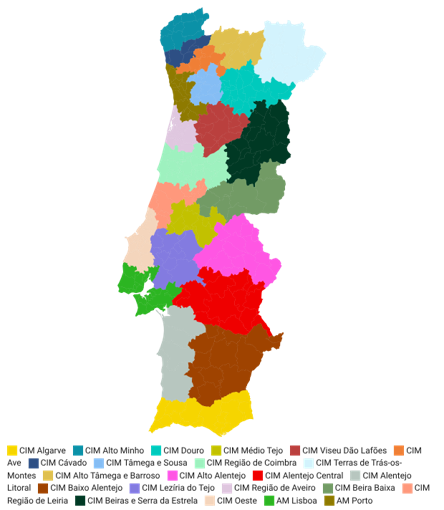
Source: Prepared by the CFP based on information from the DGAL (19 February 2025).
The framework of powers of Portuguese intermunicipal entities is the result of a gradual legislative development over recent decades:
-
Law No. 172/99 of 21 September established the common legal framework for public-law associations of municipalities.
-
Law No. 11/2003 of 13 May created the framework for intermunicipal communities and metropolitan areas, partially repealing the previous framework.
-
Law No. 45/2008 of 27 August established a new legal framework for municipal associations, formally creating the CIMs as legal persons governed by public law aligned with the territorial units for statistical purposes (NUTS), and defining their core responsibilities: the promotion of the planning and management of the territory’s economic, social and environmental development strategy, and participation in the management of programmes supporting regional development.
-
This model was consolidated and further developed by Law No. 75/2013 of 12 September, which established the legal framework for local authorities, approved the statutes of intermunicipal entities and defined the legal framework for the transfer of powers from the State to these entities, reinforcing the principles of administrative decentralisation and subsidiarity as key guiding principles.
-
The next step was taken by Law No. 50/2018 of 16 August (the Framework Law on the Transfer of Powers), which gave this process a universal and gradual character, establishing a public administration framework in which intermunicipal entities play an increasingly central role in the provision of local public services.
Intermunicipal Communities and Metropolitan Areas share the mission of promoting the planning and management of the territory’s economic, social and environmental development on a scale that exceeds the individual capacity of each municipality. To this end, they coordinate investments of supra-municipal and intermunicipal interest, participate in the management of regional development programmes, and ensure coordination between municipalities and central government in critical areas such as basic sanitation and water supply infrastructure, health and education networks, spatial planning, civil protection, mobility and transport, and cultural, sporting and leisure facilities. In addition to these inherent powers, they have responsibilities transferred by central government and powers delegated by the member municipalities, as well as representing local authorities in public and corporate entities at the supra-municipal level.
Intermunicipal entities play an essential role in the governance of public passenger transport. Law No. 52/2015 of 9 June, which approved the Legal Framework for the Public Passenger Transport Service (RJSPTP), transferred powers previously concentrated in the Institute for Mobility and Transport tion to the intermunicipal level. Within this framework, the CIMs have become the competent transport authorities for intermunicipal public passenger transport services, and may also assume municipal powers delegated by the municipalities of which they are composed. The Lisbon and Porto Metropolitan Authorities (AMs), in turn, succeeded the now-defunct Metropolitan Transport Authorities, exercising metropolitan powers in the field of mobility. This expanded responsibility covers the planning and organisation of transport provision, contracting with operators, setting fares and monitoring the service. This framework has resulted in a growing financial burden on the accounts of the EIMs, particularly since the creation of programmes to incentivise the provision and promote the use of public transport, including fare reduction measures.
More recently, this has been further developed with the creation of the Incentive Programme for Public Passenger Transport (Incentiva +TP), under Decree-Law No. 21/2024 of 19 March, which replaced and integrated previous programmes (PART and PROTransP). Incentiva +TP funds fare reduction measures, the expansion of services and the modernisation of infrastructure, the implementation of which is the responsibility of each Metropolitan Area (AM) and Intermunicipal Community (CIM) in their capacity as transport authorities. In addition, there is a measure providing free travel passes for young people up to the age of 23.[2] Incentiva +TP is funded through the allocation of part of the additional ISP levy on CO₂ emissions to the Environmental Fund (€439.2 million according to CGE/2025). Free travel passes are funded by the Treasury and Finance Authority in the form of compensatory payments to local authorities and/or intermunicipal entities (€261.9 million in 2025, as per CGE/2025). The Incentiva+TP programme has established itself as the initiative with the greatest financial impact on the accounts of the Metropolitan Areas (AMs) and Intermunicipal Communities (CIMs). However, the figures recorded by the EIMs represent only a portion of the resources associated with the programme, as part of the funding does not pass through their accounts. For example, where Metropolitan Areas have set up corporate entities to exercise their powers as transport authorities, these entities may receive funding directly from the Environmental Fund (as is the case with the AML and Transportes Metropolitanos de Lisboa (TML)). The growing scope of mobility responsibilities within the EIMs’ budgets highlights the need for access to information broken down by programme, so as to enable more detailed analysis and monitoring for each mission area.
*This Explanatory Note forms an integral part of Report 06-2026 “Local Government budget outturn in 2025”, prepared and published by the CFP in July 2026.
[1] The Setúbal Peninsula Intermunicipal Community (CIM) was formally established on 15 December 2025, bringing the total number of Intermunicipal Communities to 22. The financial analysis presented in the report covers the 21 existing CIMs during the period under review.
[2] Ministerial Order No. 307-A/2024/1, of 28 November, amended Ministerial Order No. 7-A/2024, of 5 January (which sets out the conditions for the allocation of free travel passes to young students), extending these conditions to all young people up to and including the age of 23.
Date of last update: 15/07/2026