Calendar
 Newsletter


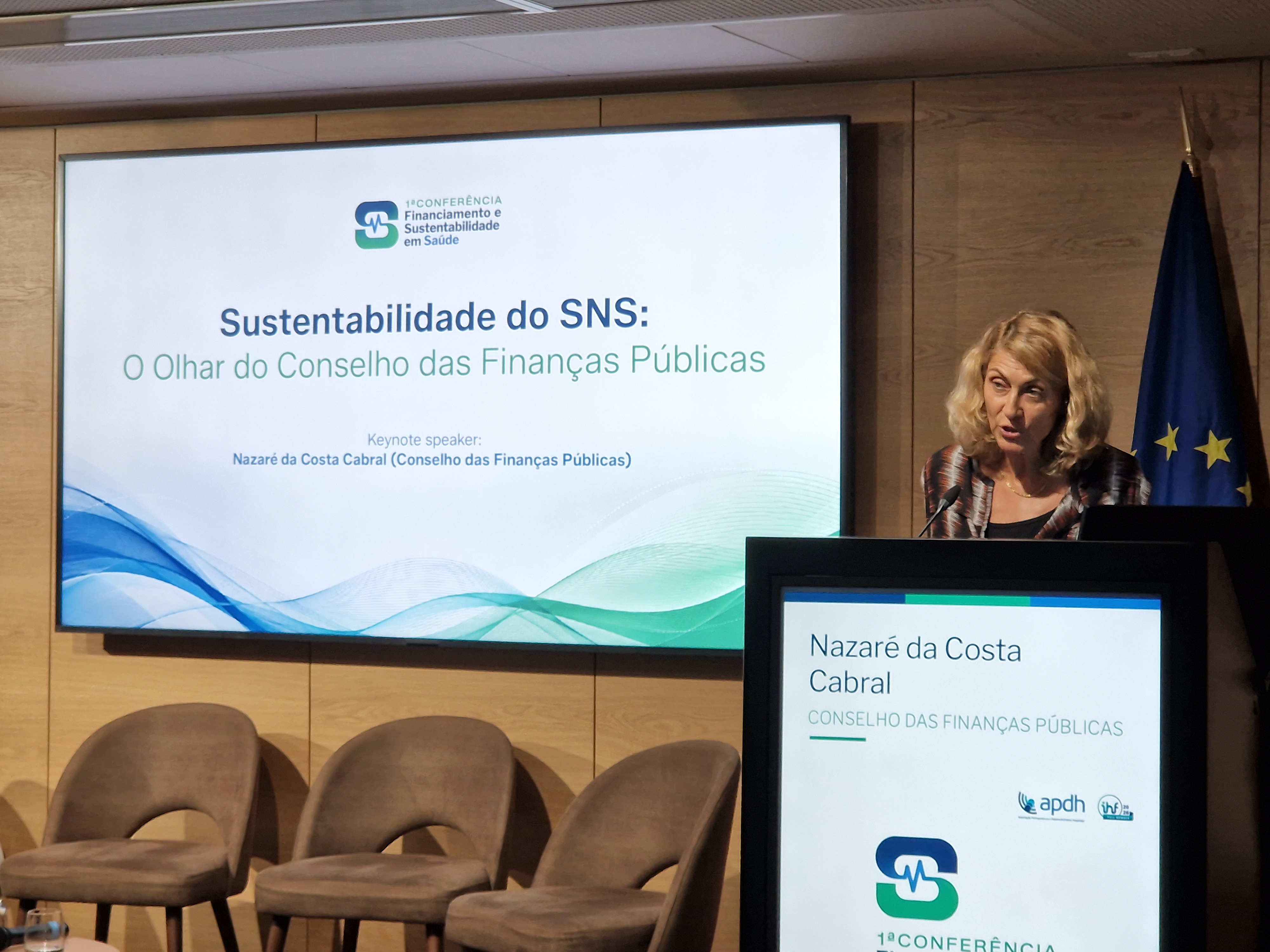
Speech by the Chair of the CFP’s Senior Board, Nazaré da Costa Cabral, at the 1st Conference on Health Financing and Sustainability, organised by the APDH – Portuguese Association for Hospital Development, on 1 July, in Lisbon.
Sustainability of the National Health Service: The CFP’s Perspective
I would like to thank the APDH management, Professor Carlos Pereira Alves and Professor Ana Escoval, who invited me for this purpose.
I would like to commend the Association for organising this conference, which I believe is both timely and relevant, given the challenges, opportunities and certain problems currently facing the National Health Service (NHS) and, more broadly, our healthcare system. Some of these challenges and problems are common to most European countries, as almost all of them are facing profound social, demographic and technological changes, and these are factors that must be taken into account in the organisation and management of any healthcare system.
As you will be aware – and I would like to thank Prof. Pereira Alves in advance for sending the CFP’s report to the conference participants – on 29 June the CFP published this very report on the performance of the NHS in 2025, following on from other reports published in recent years on this subject. In fact, it was in 2020 that the health sector began to receive regular and systematic attention from the CFP. In 2020, in the midst of the pandemic, we published an inaugural report on the evolution of the NHS between 2015 and 2019, and, from 2021 onwards, we have published an annual report on the performance of the NHS in the previous year. Therefore, the report we published last Monday analysed the situation for the year 2025. As is also customary, this report is divided into two main sections: the healthcare provision section and the fiscal section. This report forms part of a body of work alongside other documents produced throughout the year by various bodies, some of which are part of the Ministry of Health itself. Through this report, the CFP seeks, on the one hand, to contribute to increasing the level of transparency and information regarding the sector, and, on the other, to facilitate discussion and more informed decision-making based on data and figures. The aim is to promote the design and implementation of evidence-based public health policies.
At present, given the work already carried out – which, as we have seen, covers the period from 2015 to 2025, that is, a decade – we are able to gain a clearer understanding of how the NHS has evolved during this phase. As regards healthcare provision, and without wishing to bore you too much with figures, it can be said that the NHS has grown from just over 10 million users to 10.7 million; in other words, it now has 700,000 more users. There has also been a significant increase in the number of users without a family doctor – there were just over 700,000 in 2016, and now, in 2025, the figure stands at over 1.5 million users. In this regard, there is a marked regional imbalance, with the shortage of family doctors relative to existing needs being concentrated in the Greater Lisbon region. In the rest of the country, by contrast, I do not believe this shortage can be considered critical.
With the exception of the pandemic years, there has been a certain stabilisation or modest growth over this period in some of the key indicators for healthcare provision, such as, first and foremost, medical and other consultations within the primary healthcare network, as well as hospital consultations. As regards the care of chronic patients and scheduled access to surgery, the number of beneficiaries has increased somewhat more markedly. On the other hand, the long-term care network – both in terms of inpatient beds and home care places – has grown at a moderate rate.
Whilst it is true that, in terms of care provision, the trend has therefore been one of somewhat moderated growth over the decade, in fiscal terms, the trend has been on a different scale. In fact, both the increase in public expenditure on the NHS and the increase in the State’s financial contribution have been much more pronounced. Current expenditure on the NHS (which accounts for almost all expenditure in this sector) has increased by around 84% over this decade, rising from 8,800 million euros (M€) in 2016 to 16,200 M€ in 2025. It is worth noting the proportion accounted for by the supply of goods and services, which represents 56% of the total current expenditure, with the remaining 44% accounted for by staff costs. The proportion of the latter item has, moreover, increased in recent years. The annual rate of change in NHS expenditure has accelerated significantly, rising from an average of 5.8% in the 2015-2019 sub-period to an average of 8.9% in the most recent period, 2024-25. In turn, the State’s financial contribution to the NHS has doubled over the past decade, rising from 8,100 to 16,200 M€, as a result of the declining share of other funding sources – e.g. user charges – observed throughout this period. This means that the NHS is increasingly funded through taxation and there is, therefore, less diversification of funding sources in this sector.
This imbalance – whether real or apparent, as some might argue – between growth in healthcare provision and growth in fiscal or budgetary resources raises the question of whether, and to what extent, the resources allocated to the sector are being used in the most efficient and effective manner by the NHS and, in particular, the question of whether the outcomes in terms of healthcare provision should not, in themselves, be better or even better. In turn, maintaining growth rates in NHS expenditure at the level seen in recent years – well above the growth rates of other general government expenditure and well above the nominal growth of the Portuguese economy – is quite simply not sustainable in the medium to long term. Therefore, as we state in the report now published, it is increasingly important to strengthen – and I quote – “the mechanisms for managing and controlling NHS expenditure, so as to ensure greater efficiency in the use of public resources and fiscal planning that is better aligned with the system’s actual needs.” We are aware of the harmful consequences resulting from this lack of multi-annual planning of NHS expenditure and funding requirements: the practice of under-budgeting significant portions of expenditure, to create a false impression of containing its growth, when in reality it acts as an incentive – perhaps a perverse one – to increase spending and expenditure. As mentioned once again in the CFP Report – and I quote again – “in this context, there is a clear need for a structural approach geared towards strengthening planning and transparency, involving realistic initial budgeting in line with known needs and the monitoring of the main sources of pressure on expenditure identified (…), thereby promoting greater alignment between available resources and the NHS’s healthcare objectives.”
From a structural perspective, the diagnosis has been made both regarding the exogenous factors placing pressure on the NHS and regarding the internal organisational entropies of the system. The organisational reform carried out in recent years has sought to strengthen the autonomy and management capacity of service providers through new planning and coordination tools. However, no significant savings or efficiency gains resulting from these organisational and managerial changes have yet materialised. Furthermore, as also noted in the CFP Report, the persistent discrepancies between the initial budget and the actual expenditure of the NHS highlight recurring difficulties in planning healthcare provision and anticipating the associated costs.
In conclusion, I believe that the major challenge facing the NHS, whether at the macro level of health policy design or at the micro level of organisation and management, lies in reorganising and better combining existing resources – first and foremost human, technical and technological resources – to meet the healthcare needs we will face in the coming years, whilst taking into account their geographical distribution across Portugal. We must recognise that resources are scarce and that it is necessary to set priorities whilst at the same time creating mechanisms to contain moral hazard, a central feature of how the healthcare market operates. It may be necessary to admit – which may cause some disappointment – that the NHS, contrary to the idealised vision, does not in fact possess the gift of ubiquity: the ability to be everywhere, at the same time, for everything, and in the same way. This disenchanted tone may well displease those who view the right to health as a universal right. Even if it is validly regarded as such, it is also true that health is not strictly speaking a free good. It is not the air we breathe. It is an economic good, one that has an economic cost – and is, in , an expensive one – and this very fact necessitates making choices. We hope that those in charge – first and foremost policy-makers – will be able to make the right choices, based on evidence and, in particular, on projections of trends in key variables and indicators, whilst anticipating their future impacts on the healthcare system and on the NHS in particular.
Thank you very much for your attention.
Date of last update: 07/07/2026